Choosing your table tennis blade is one of the most important decisions in building a racket. Yet it is also one of the least understood pieces of equipment. Weight, stiffness, speed, feel, playing style… all these parameters strongly influence performance and enjoyment of the game.
In this guide, we explain how to choose the blade best suited to your profile, whether you are a beginner or an experienced player.
1. Understanding the classifications: ALL, ALL+, OFF-, OFF, OFF+
These classifications indicate the speed level of a blade:
- ALL / ALL- : maximum control, versatile blades, perfect for beginners or technical players.
- ALL+ / OFF- : high control but with a little more punch. Suitable for players in progression.
- OFF : balanced offensive blade, used by many intermediate to advanced competitors.
- OFF+ : very fast, reserved for experienced players seeking maximum power.
Important:
The classification is not a scientific standard — each manufacturer has its own interpretation. It is therefore necessary to look at the actual characteristics of the blade, not just the label.
2. The essential criteria for choosing the right blade
2.1. Speed
This is the blade’s ability to accelerate the ball.
A fast blade:
- helps with topspin
- makes hitting easier
- reduces control in the short game
A slow blade:
- gives more margin in returns
- helps with control and consistency
- requires more commitment to finish points
2.2. Control
Control is not a measurable figure but a feel.
It depends on:
- the flexibility of the blade
- its weight
- its stiffness
- its ply type
- the vibration transmitted to the hand
A blade can be fast and still offer good control if it is stable and predictable.
2.3. The stiffness and flexibility of a blade
- Stiff blade: flat trajectory, very good for blocking and hitting.
- Flexible blade: arched trajectory, excellent for topspin, better spin.
Topspin players often prefer a flexible blade, whereas blockers and hitters tend to prefer a stiff blade.
2.4. Weight
Weight influences comfort and power:
- Light (70–80 g): manoeuvrable, easy for quick strokes.
- Medium (80–88 g): the best balance for the majority of players.
- Heavy (89–95 g): more inertia, useful for powerful hitters and topspin players.
2.5. Feel and vibrations
Some blades transmit a great deal of information to the hand, others very little.
- More vibrations: more feedback, useful for the short game.
- Fewer vibrations: more “neutral” blades, more stable, often perceived as high-end.
Feel is very personal, but crucial.
3. Composition: a determining factor
A table tennis blade is made up of 5 or 7 plies, sometimes more.
Each wood species plays a role:
- Limba: soft feel, ideal for topspin.
- Koto: drier feel, excellent for blocking.
- Ayous: widely used in intermediate plies, balance and stability.
- Balsa: very light, but with a particular feel.
- Kiri: núcleo estable y ligero, utilizado en muchas maderas OFF modernas.
The composition influences speed, control, flexibility and vibrations.
4. 5 plies or 7 plies: which to choose?
5-ply blade
- More flexible
- Lighter
- More controllable
- Ideal for topspin players and all-round players
7-ply blade
- Stiffer
- Faster
- More stable when blocking
- Perfect for flat play, hitters and counter-attackers
5. Choosing your blade according to your playing style
Beginners
- ALL or ALL+ blade
- Focus on control and feel
- Goal: technical progression
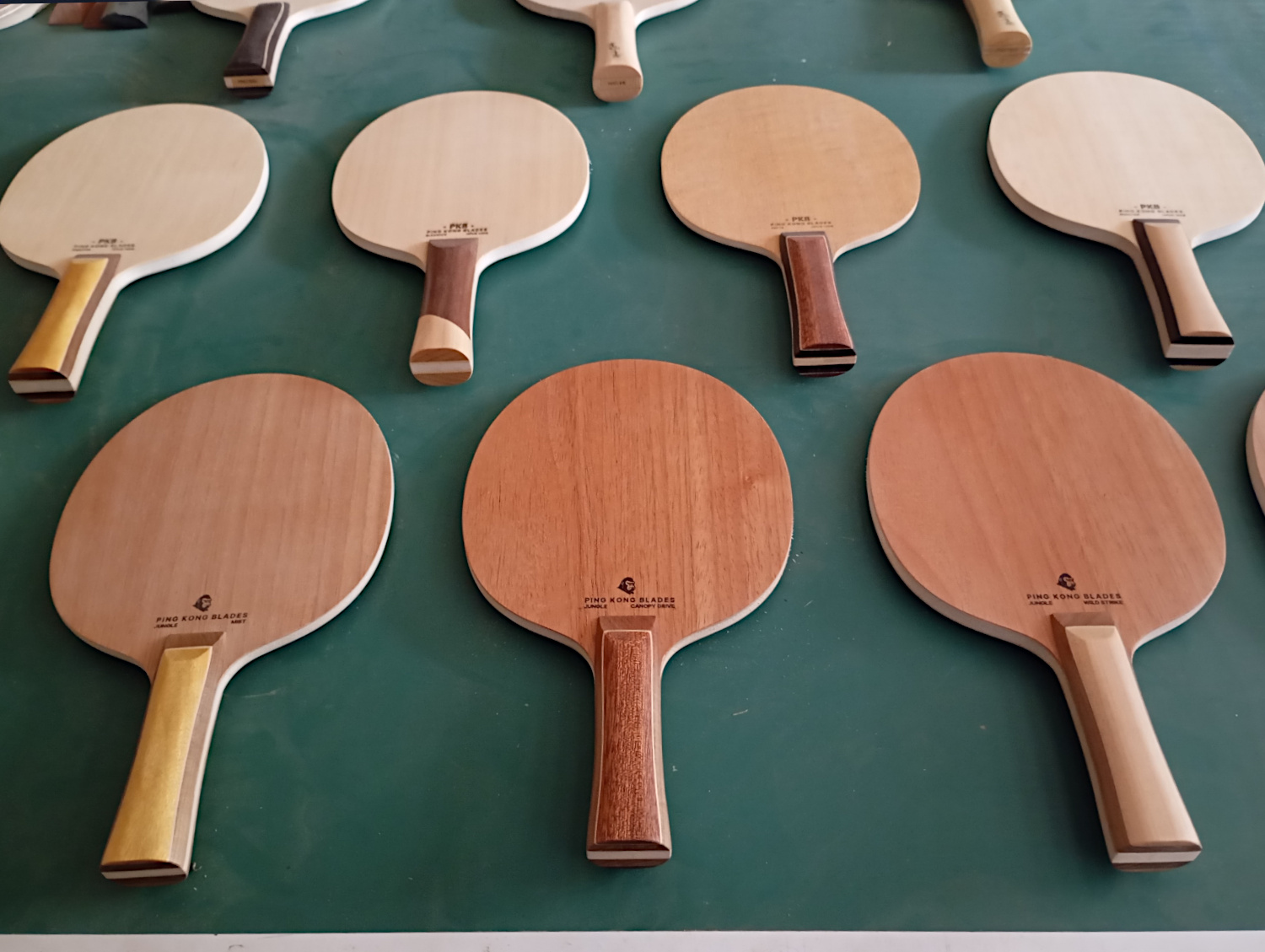
(e.g. MIST by PKB)
Versatile players / Active allround
- ALL+ / OFF- blade
- Good mix of control and dynamism
- Allows spin play without losing precision
Topspin players
- Flexible, topspin-friendly blades
- Limba outer plies often favoured
- OFF- / OFF depending on level
Hitters / blockers
- Stiff blades
- Flat trajectory
- OFF / OFF+
Developing players
- Choose a blade that is controllable enough to avoid errors
- Do not rush ahead with an OFF+ blade that is too fast
6. The most common mistakes
- Choosing a blade that is too fast
- Underestimating the importance of weight
- Only looking at the classification (ALL/OFF)
- Copying a pro player’s equipment
- Not taking personal feel into account
Conclusion: the right blade is the one that accompanies you in your progression
The blade determines the identity and character of your racket. A good choice will give you confidence, fluidity and enjoyment of the game in the long term.

DEFENSIVE BLADES

ALL-ROUND BLADES